
Marshalltown Directory Years on Record
Known Marshalltown historical directory editions span 1891 through 1960, but they do not form one unbroken annual run. Catalog and microfilm references identify early volumes from 1891, 1894, 1897, 1899, and 1900, followed by a broad set of twentieth-century editions. The Allen County Public Library microfilm reference is especially useful for 1902 through 1934 and selected later years. Individual scans may also appear through national directory catalogs. Because current shelf holdings at Marshalltown Public Library were not published in a full catalog, call the library before planning an in-person visit.
| Marshalltown collection | Years represented | Where to check | Access note |
|---|---|---|---|
| Early historical volumes | 1891, 1894, 1897, 1899, 1900 | National catalogs and scans | Scan access depends on the collection |
| Microfilm reference run | 1902-1934, plus selected 1937-1960 editions | Allen County Public Library reference | Confirm the exact year before use |
| Marshalltown telephone pages | 1951-1956 reel, with related 1943-1950 and 1957-1963 reels | Library of Congress | Free digitized page images |
| Local newspaper archive | Titles beginning in 1858 | Marshalltown Digital Archives | OCR search and scanned pages online |
A missing year is only a gap in the known run. It does not show that a person left Marshalltown. Note the title, edition year, page number, and repository for every hit. Also distinguish a household-style volume from white pages or yellow pages. The latter may list a subscriber or business without the spouse, occupation, or household marks found in some editions.
Marshalltown's Newspaper Directory Backstop
The Marshalltown Digital Archives is the strongest verified local name-search collection when a printed directory year is absent. In August 2026, the archive displayed 50,766 pages for the Evening Times Republican and 22,877 for the Marshalltown Times Republican. Earlier titles include the Marshall County Times, Marshall Statesman, Reflector, and Electric Light. Those overlapping runs can reveal notices, local events, addresses, institutions, and obituary clues.
OCR, the computer-read text behind a scanned page, often misreads worn type. Search a surname alone, then add a street or institution as a second term. Try initials, older spelling, and nearby years. The advanced archive search offers people, places, events, location, title, and date controls. A newspaper result should lead back to the image, since the scan shows what the text engine may have missed.
Marshalltown Library Directory Access
Marshalltown Public Library, 105 W Boone Street, actively collects local-history and Iowa material, but its public pages do not state a separate genealogy-room schedule or complete historical shelf list. Call 641-754-5738 with the exact edition year, surname, and street before visiting. Ask whether the item is a bound volume, microfilm, telephone book, or digital scan, and whether staff can check a page when travel is not practical.
The state archives provide the strongest published inventory of older county series. The official Marshall County archival holdings page shows the breadth of that fallback:
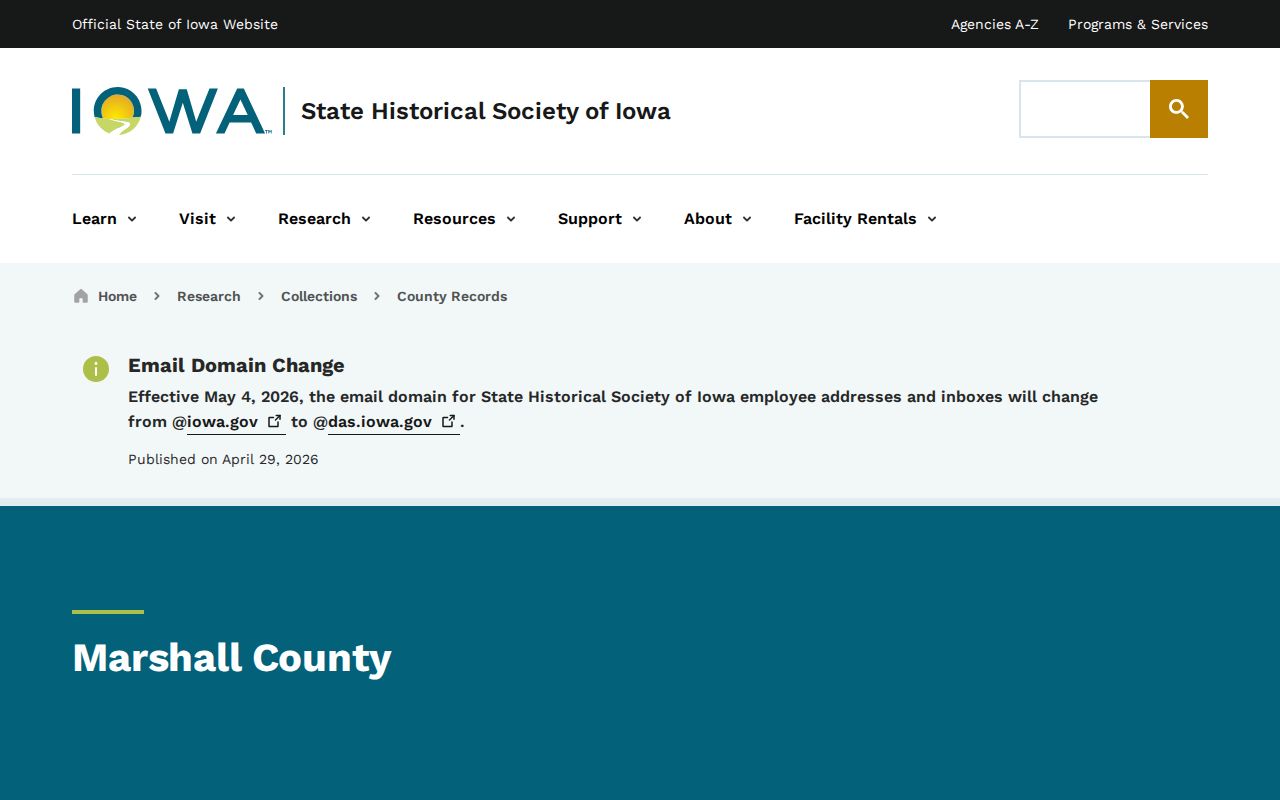
The screenshot helps separate a catalog entry from an online image. Once a city directory supplies a name or address, the listed probate, town-lot, marriage, naturalization, and deed series can point to the proper reading-room request. The State Historical Society's Des Moines Research Center publishes hours of Wednesday through Friday, 9:00 a.m. to 4:30 p.m., and Saturday, 9:00 a.m. to 3:00 p.m. Archives and special collections may merit advance contact even though a general appointment is not usually required.
Read a Marshalltown Directory Entry
First identify the kind of page. An alphabetical subscriber page, a public-building list, and a classified business page do not carry the same facts. The Library of Congress Marshalltown reel is labeled as Iowa white and yellow pages for February 1951 through March 1956. Its visible fields can include locality, date, subscriber, street address, telephone exchange, public office, and business category. Do not add a spouse or household role unless the actual entry prints it.
| Edition and locality | Confirm that the page covers Marshalltown and record its date. |
|---|---|
| Page type | Mark it as alphabetical, public-building, classified, or address ordered. |
| Name or institution | Copy spelling, initials, and any printed cross-reference exactly. |
| Street address | Transcribe the number, direction, and street form as printed. |
| Phone detail | Preserve the exchange and number as an era-specific clue. |
- Criss-cross directory
- A directory arranged by street address instead of a person's surname.
- Householder index
- An address-order list that may identify the person linked to each listed home.
- Abbreviation key
- The edition's own list of short forms and symbols. Read it before interpreting any mark.
Marshalltown Names Before City Directories
The printed run begins much later than Marshall County's surviving civil records. The State Historical Society's Marshall County holdings list deed books from 1850, town-lot records from 1855, probate files from 1847, marriage material from 1850, and naturalization records reaching from the 1850s into the twentieth century. These are finding aids for archival series, not a promise that each page is online.
The 1878 county history adds biographies, portraits, settlement accounts, maps, and local statistics. That volume works like an early name source, but its biographical scope is selective. Pair a name there with the legal series that fits the event. A town-lot entry may establish a property link, while probate or marriage records may show a family relationship.
When Marshalltown Records Moved
Marshall County was organized in 1846. The official courthouse history says the county seat moved to Marshalltown in 1859 and the records traveled overnight by oxen. Early references may therefore use Marietta, Marshall, or Marshalltown. The name change is more than local color. It affects which place term may appear in a deed, court book, newspaper page, or catalog description.
| 1850s | Early deeds, town lots, probate, marriage, and naturalization series begin. |
|---|---|
| 1859 | The county seat and records move to Marshalltown. |
| 1903 | The Carnegie library opens as a lasting local-history institution. |
| 1951-1956 | The digitized Library of Congress telephone reel provides a mid-century check. |
Marshalltown's Riverside Name Bridge
The Riverside Cemetery collection reports 36,060 records and 17,623 images. Its burial index, plat book, lot records, registers, care records, and lot-owner entries can connect a surname with a physical place. That is useful when a Marshalltown city directory entry stops appearing and the newspaper archive suggests a death.
Follow the name from a burial card to the lot, then compare nearby family names. Next search an obituary, probate index, and deed if property is involved. Cemetery evidence does not prove where someone lived, and a lot owner is not necessarily the person buried there. It supplies a place-based link that can guide the next search.
Trace Family Through Marshalltown Directories
A good family trail uses each directory as a dated snapshot. Begin with the closest known year and work both ways. Preserve initials and street directions, since common names and changed street forms can split one person into several false matches. Census years help test the decade, while newspapers can fill the years between printed editions.
- Search the newspaper archive by surname, then add a Marshalltown street, church, school, or year.
- Check the nearest alphabetical directory edition and save the exact page citation.
- Use an address section or telephone page to test the street entry when one exists.
- Compare the directory year with the nearest census and with county probate or marriage indexes.
- For a deceased person, check Riverside Cemetery and then return to newspapers for an obituary or notice.
Absence has several causes. A person may have moved, died, stopped subscribing, changed a name, lived outside the volume's coverage, or been missed by the publisher. Search the next and prior editions before drawing a conclusion. For a modern address-based owner trail, use the Marshalltown street directory methods instead of extending a historical listing into the present.
Note: A Marshalltown directory hit is a dated clue, not proof that the named person occupied the address for the full year.